
Main author: Redaktion SASEG DOI: 10.1234/geonews.2025.001
Institution:
SASEG
Keywords Alps CO2 storage Geology Research
Geological screening of rock formations for CO₂ mineralisation in Switzerland
Results of the CARBOSTORE-CH project
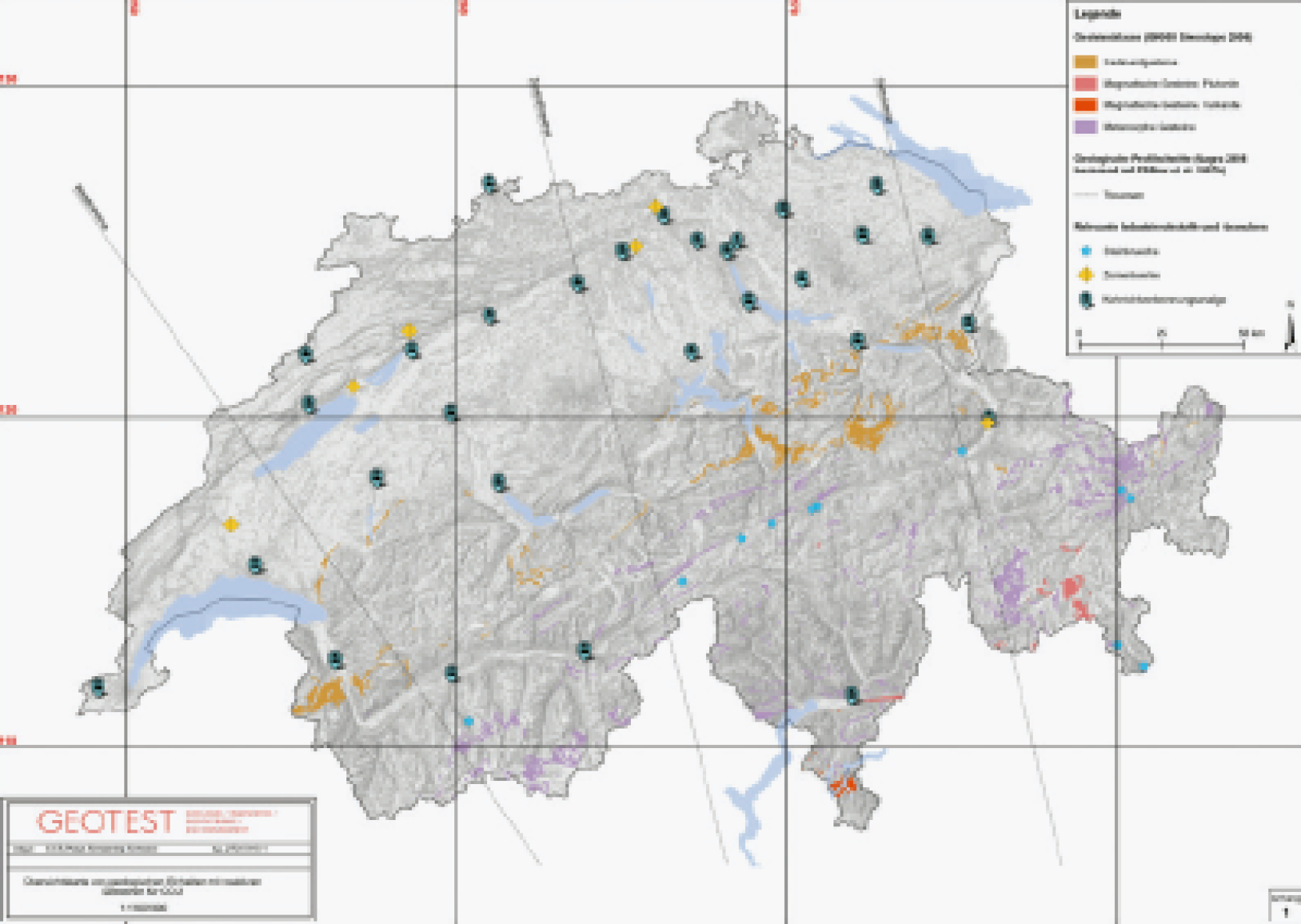
As part of the CARBOSTORE-CH project, the potential for CO₂ mineralisation of natural rock formations in Switzerland was investigated on behalf of the Swiss Federal Office of Energy (SFOE) and with the financial support of the Association of Operators of Swiss Waste Utilisation Plants (VBSA). The investigation includes the identification of reactive minerals and, derived from this, the definition of potentially reactive host rocks in Switzerland.
Zusammenfassung
Im Rahmen des Projekts CARBOSTORE-CH wurden im Auftrag des Bundesamtes für Energie (BFE) und mit finanzieller Unterstützung des Verbands der Betreiber Schweizerischer Abfallverwertungsanlagen (VBSA) die Anwendungsmöglichkeiten für die CO2-Mineralisation in geogenen Wirtgesteinsvorkommen in der Schweiz untersucht. Die Untersuchung umfasst die Identifikation von reaktiven Mineralien und daraus abgeleitet die Festlegung von potenziell reaktiven Wirtgesteinen in der Schweiz.
A. Florentin Ladner1, Daniela van den Heuvel2, Larryn W. Diamond2, Moira Arnet1
1 GEOTEST AG, Freilager-Platz 3, CH-4142 Münchenstein
2 Institute of Geological Sciences, University of Bern, Baltzerstrasse 1+3, CH-3012 Bern
1 Introduction
The results of the CARBOSTORE-CH project were presented at the 91st Annual Meeting of SASEG in Basel in 2025. The project was carried out on behalf of the Swiss Federal Office of Energy (SFOE) with financial support from the Association of Operators of Swiss Waste Utilisation Plants (VBSA) and investigated the potential for CO2 mineralisation in natural host rock formations in Switzerland. GEOTEST AG and the Rock-Water Interaction Group of the University of Bern formed a consortium for this purpose, with GEOTEST AG in charge of overall project management. The VBSA acted as industry partner. The project was accompanied by the Federal Office for the Environment (FOEN), swisstopo and cemsuisse. This article summarises the key findings of the CARBOSTORE-CH project. The full final report is published and publicly available in the ARAMIS research database of the Federal Administration (Ladner et al., 2023).
2 Geological storage of CO2 as a fluid
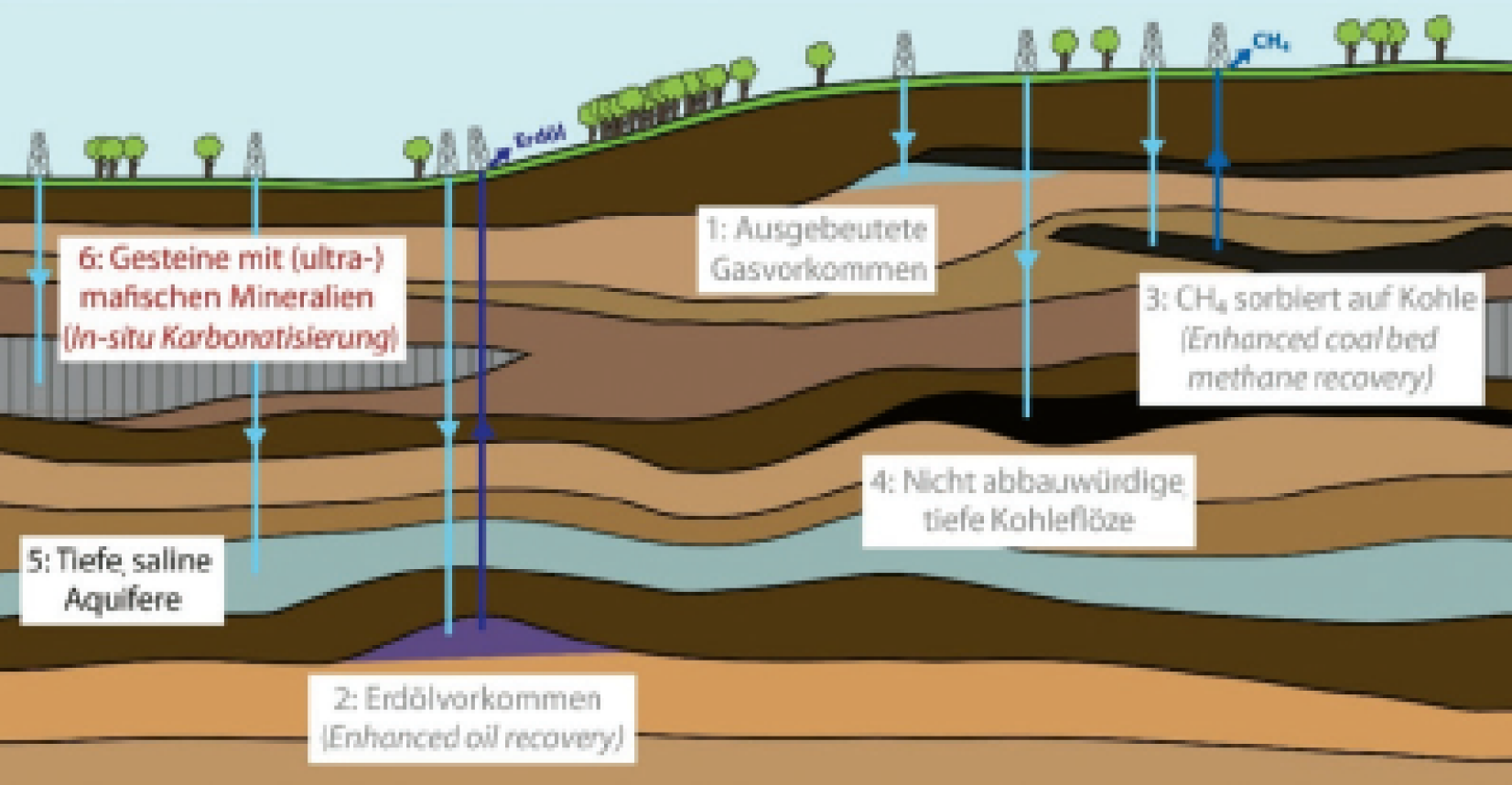
The geological subsurface offers numerous options for storing CO2 safely over the long term. Several of these are linked to the ongoing or past extraction of fossil fuels (i.e. oil, gas and coal) (Fig. 1).
Depleted oil and gas reservoirs can be refilled directly with CO2. These reservoirs have demonstrated that they possess the necessary permeability and volume and that they remain sealed over geological timescales, making them ideal formations for CO2 sequestration. CO2 is also sequestered as a by-product of hydrocarbon production through enhanced oil recovery: the injection of CO2 mobilises residual oil and gas in the reservoir while the injected CO2 remains underground. A similar approach is used in enhanced coal bed methane recovery (e.g. White et al., 2005), where CO2 is pumped into unmineable coal seams and replaces the methane adsorbed on the coal surface. This mobilises natural gas that cannot be produced by conventional methods while sequestering CO2 underground. Sorption of CO2 on coal can also take place without methane production in deep, unmineable coal seams and then serves CO2 sequestration alone (Fig. 1).
All of these methods are applied in various regions of the world that are rich in fossil resources (e.g. the USA, Canada, China and Poland). In Switzerland, however, these storage options are of little relevance, as no major hydrocarbon or coal deposits are known (Leu, 2012). To date, only a single, very small gas field has been developed in Switzerland, through the Finsterwald deep well in the canton of Lucerne, which was exploited between 1985 and 1994 and yielded a total of about 74 million m3 of gas (Lahusen et al., 1995). The well was subsequently backfilled.
Coal deposits with seams up to 4 m thick are known in Switzerland from the Weiach borehole in the Permo-Carboniferous trough of northern Switzerland. Pini et al. (2010) investigated the sorption potential of these coal seams and concluded that their suitability for CO2 sequestration is rather low. Numerous further Permo-Carboniferous troughs are presumed to exist in the Swiss subsurface; whether they contain coal and, if so, what properties the seams have, is unknown.
A more promising sequestration option for Switzerland is the storage of supercritical CO2 in saline aquifers of the Swiss Plateau. This option was investigated in detail within an SFOE project (Diamond et al., 2010). The associated potential study (Chevalier et al., 2010) is based on purely geological criteria and on data from more than 150 scientific publications as well as unpublished data from hydrocarbon exploration in Switzerland. These data were evaluated using the modified assessment scheme for CO2 storage in deep aquifers (Chadwick et al., 2008). It was shown that the sedimentary rocks of the Molasse Basin and, to some extent, the equivalent formations of the Jura have a moderate to high potential for CO2 sequestration. At least four sandstone or carbonate reservoirs occur within the desired depth range (800–2500 m) across large parts of the Molasse Basin and beneath the Jura Mountains. Considering all geological criteria together, the Fribourg – Olten – Lucerne region in particular shows a sequestration potential of > 0.6 (maximum = 1). The theoretical storage volume in this area is approximately 2,680 Mt CO2. The result of this literature study is therefore promising, but must be confirmed or adjusted by more detailed investigations. For the Triassic Muschelkalk, the potential in the central to eastern Molasse Basin has already been examined in more detail (Diamond et al., 2019). It emerged that the petrophysical properties of the formation at greater depths are poorer (i.e. less porous and permeable) than expected. The actual potential is therefore likely to be lower than originally determined by Chevalier et al. (2010).

3 Geological storage of CO2 as a solid carbonate (CO2 mineralisation)
The focus is on two methods of CO2 mineralisation using mafic / ultramafic minerals:
| Method | Procedure |
|---|---|
| Ex situ | Reactive mafic and ultramafic minerals are mined, crushed and transported to a site where captured CO₂ is available as a fluid. Carbonation then takes place in an accelerated manner under controlled conditions (pH, temperature and pressure) in a purpose-built reactor vessel. |
| In situ | CO₂ is injected through boreholes into a rock formation containing reactive mafic and ultramafic minerals. Where natural permeability exists, the CO₂ circulates within the rock and is mineralised. |
Chemical reactions of CO2 mineralisation
The basic principle of CO2 mineralisation or carbonation (in situ or ex situ) describes the formation of carbonate minerals from CO2, water and divalent cations (e.g. Ca2+) that are released from a geological formation or from mined rock. This process consists of three steps and occurs naturally in nature.
Step 1
Gaseous CO2 (CO2(g)) dissolves in water (CO2(aq)) and forms the following equilibrium with carbonic acid:
CO2(g) ↔ CO2(aq)
CO2(aq) + H2O ↔ H2CO3(aq)
Step 2
The silicate minerals present in the reservoir – here Mg-olivine as an example – are dissolved by the carbonic acid and release divalent cations. This is favoured by a decrease in pH caused by the dissolution of CO2 in the formation water:
Mg2SiO4 + 4 H2CO3(aq) ↔ 2 Mg2+ + 4 HCO3−(aq) + H4SiO4(aq)
Step 3
The cations combine with the bicarbonate ions (HCO3−) present in solution and precipitate as solid carbonate minerals – in this example magnesite (MgCO3):
HCO3−(aq) + Mg2+ ↔ MgCO3(s) + H+(aq)
Taken together, these three steps give the following overall chemical reaction for the carbonation of Mg-olivine:
Mg2SiO4 + 2 CO2 + 2 H2O ↔ 2 MgCO3(s) + H4SiO4
The by-product H4SiO4 is harmless and normally precipitates as an amorphous gel that dehydrates to quartz (SiO2) over time. By analogy with Mg-olivine, all minerals that contain divalent cations (but no CO2) can theoretically carbonate. The most common cations are Ca, Mg and Fe, which form the carbonate minerals calcite (CaCO3), magnesite (MgCO3), dolomite (CaMg(CO3)2) and siderite (FeCO3). Under certain conditions (i.e. T < 65 °C) hydrated carbonates such as hydromagnesite (Mg5(CO3)4(OH)2·4H2O) or nesquehonite (MgCO3·3H2O) form instead. Other divalent cations (e.g. Mn, Sr, Zn or Pb) can also form carbonate minerals, but do not occur in most rock formations in sufficiently high concentrations to be of interest for carbonation. Certain other cations that are very common in rocks (in particular Si and Al) do not form stable carbonate minerals. It follows that the rocks with the highest contents of Ca, Mg and Fe and the lowest contents of CO2 (all values on a molar basis, not by weight) are the most suitable feedstocks for carbonation. Optimal rocks are thus characterised by mol(Ca+Mg+Fe) – mol(CO2) ≫ 1.
From a chemical point of view, the rocks best suited to carbonation are mafic and ultramafic igneous rocks (above all basalt and peridotite), their metamorphic equivalents (e.g. greenschist and serpentinite) and individual sedimentary formations (e.g. sandstones rich in glauconite or hematite; Hills et al., 2020).
Advantage of CO2 mineralisation in mafic and ultramafic rocks
The advantage of CO2 mineralisation lies in the kinetics of the chemical reactions. With mafic and ultramafic rocks these proceed many times faster than, for example, the sequestration of CO2 in saline aquifers. Saline aquifers therefore require an intact, stable caprock so that the CO2 cannot escape. With CO2 mineralisation in mafic and ultramafic rocks, the CO2 is mineralised so quickly and converted into a state that is stable over geological timescales that the risk of unwanted CO2 escape is smaller.
References
Chadwick, A., Arts, R., Bernstone, C., May, F., Thibeau, S. & Zweigel, P. 2008: Best practice for the storage of CO2 in saline aquifers – observations and guidelines from the SACS and CO2STORE projects (Vol. 14). British Geological Survey.
Chevalier, G., Diamond, L.W. & Leu, W. 2010: Potential for deep geological sequestration of CO2 in Switzerland: a first appraisal. Swiss Journal of Geosciences 103, 427–455.
Diamond, L.W. 2019: Revised potential of the Upper Muschelkalk Formation (Central Swiss Plateau) for CO2 storage and geothermal electricity. Slides of an oral presentation at the SCCER-SoE Annual Conference at EPFL-Lausanne, 4.9.2019.
Diamond, L.W., Leu, W. & Chevalier, G. 2010: Studie zur Abschätzung des Potenzials für CO2-Sequestrierung. Report commissioned by the Swiss Federal Office of Energy SFOE (SI/500325-01 and SI/500386-02), Bern, 23 pp.
Hills, C.D., Tripathi, N. & Carey, P.J. 2020: Mineralization technology for carbon capture, utilization, and storage. Frontiers in Energy Research 8, 142.
Ladner, F., van den Heuvel, D., Arnet, M. & Diamond, L.W. 2023: CARBOSTORE-CH. Geologisches Screening von Gesteinsvorkommen für CO2-Mineralisation in der Schweiz. Final report.
White, S.K., Spane, F.A., Schaef, H.T., Miller, Q.R., White, M.D., Horner, J.A. & McGrail, B.P. 2020: Quantification of CO2 mineralization at the Wallula Basalt Pilot project. Environmental Science & Technology 54(22), 14609–14616.